

When asking for an update, clarity is your best friend. You don’t want to confuse the reader or force them to guess what you’re referring to. Always mention the specific task, project, or timeline you’re asking about. This reduces back-and-forth communication and makes your message more effective.
At the same time, brevity matters. Long, complicated messages can dilute your main request and make it harder to respond quickly. The ideal message is one that gets straight to the point while still sounding polite and professional. Think of it as a balance between being informative and being concise.
Clarity also helps avoid misunderstandings. If your request is vague, the response you get might not be what you actually need. Being precise saves time for both you and the recipient, making the entire communication process smoother and more efficient.
Professional Ways To Ask For An Update By Email
- Update Request on [Project Name]
- Checking In: Status of [Task]
- Follow-Up on Previous Discussion
Short Professional Ways To Ask For An Update
- Hi, just checking in on the progress of [task].
- Quick follow-up on [project]; any updates?
- When you have a moment, could you share an update on this?
Professional Ways To Ask For An Update From Manager
- I’d appreciate your guidance on the current status of this task.
- Could you please share any updates when convenient?
- I want to ensure I’m aligned; do you have any updates on this?
Professional Ways To Ask For An Update From Colleague
- Hey, hope everything’s going well. Any updates on your part?
- Let me know if you need anything from me; just checking on progress.

- Whenever you’re free, I’d love an update on this.
Best Professional Ways To Ask For An Update On Project
- Could you share the current progress on the project milestones?
- Are we on track for the upcoming deadline?
- Any updates on the deliverables for this week?
Explore More: 37+ Sympathy Card Messages For Coworker
Formal Professional Ways To Ask For An Update
- I would appreciate an update at your earliest convenience.
- Kindly provide the current status of the project.
- May I request an update regarding this matter?
Professional Ways To Ask For An Update Politely
- Hi, I hope you’re doing well. I wanted to check if there are any updates on this.
- Just following up on my previous message; any news to share?
- Whenever you have a moment, I’d appreciate an update.
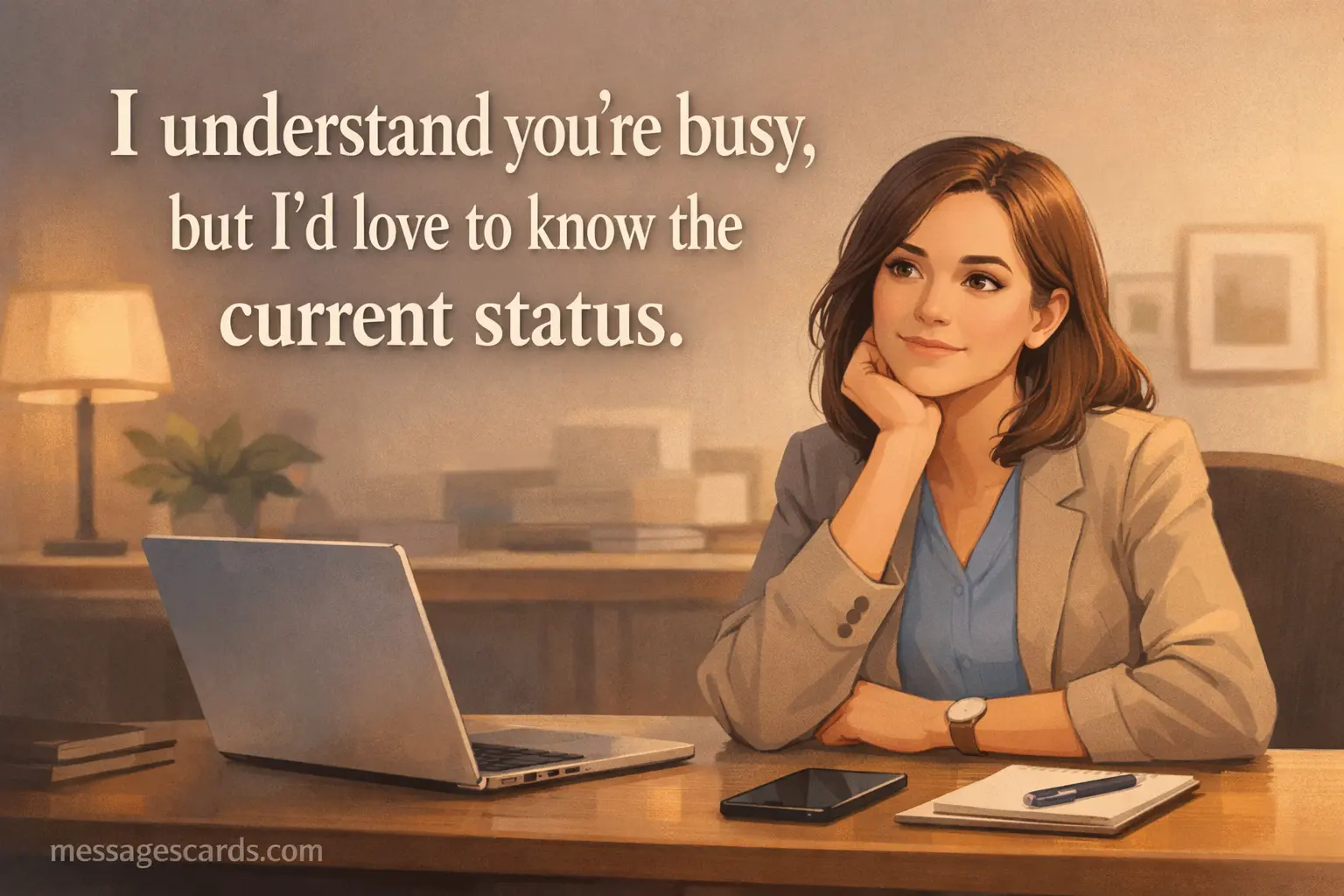
- I understand you’re busy, but I’d love to know the current status.
Check Related: 53+ Encouraging Messages For Kids With Kind Words
- Could you please share an update when convenient?
- I’m checking in to see how things are progressing.
- Any updates would be greatly appreciated.
- Looking forward to your update when you’re available.
- Please let me know if there’s any progress on this.
- I’d be grateful for any update you can provide.
For more creative ways to ask for an update, contact our team.
FAQs
1. How often should I follow up for an update?
It depends on the urgency, but generally waiting 2–3 business days is appropriate before sending a follow-up message.
2. What is the most polite way to ask for an update?
Using phrases like “Whenever you have a moment” or “I’d appreciate an update” keeps your tone respectful and professional.
3. Is it okay to ask for updates daily?
Only if the task is highly time-sensitive. Otherwise, daily requests may feel overwhelming or pushy.
4. How can I ask for an update without sounding rude?
Add context, use polite language, and acknowledge the other person’s time and workload.
5. Should I use formal or informal language?
It depends on your relationship with the recipient. Use formal language for managers or clients and a slightly relaxed tone for colleagues.

Logan Mitchell is an American blogger and professional content strategist from Seattle, Washington, known for his expertise in online publishing and editorial content development. With nearly a decade of hands-on experience, Logan has built a reputation for delivering well-researched, trustworthy content across multiple niches, including communication, relationships, and digital expression. Through his work on messagescards.com, he helps users discover impactful messages and thoughtful wording tailored to real-life situations. His writing style blends professionalism with a human touch, making his content both reliable and easy to connect with.